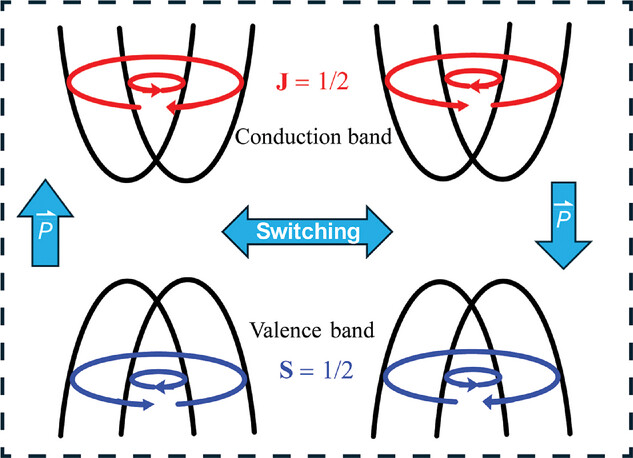
Organic–inorganic hybrid metal halide perovskites carrying strong spin-orbital coupling (SOC) have demonstrated remarkable light-emitting properties in spontaneous emission, amplified spontaneous emission (ASE), and circularly-polarized luminescence (CPL). Experimental studies have shown that SOC plays an important role in controlling the light-emitting properties in such hybrid perovskites. Here, the SOC consists of both orbital (L) and spin (S) momentum, leading to the formation of J (= L + S) excitons intrinsically involving orbital and spin momentum. In general, there are three issues in determining the effects of SOC on the light-emitting properties of J excitons. First, when the J excitons function as individual quasi-particles, the configurations of orbital and spin momentum directly decide the formation of bright and dark J excitons. Second, when the J excitons are mutually interacting as collective quasi-particles, the exciton–exciton interactions can occur through orbital and spin momentum. The exciton–exciton interactions through orbital and spin momentum give rise to different light-emitting properties, presenting SOC ordering effects. Third, the J excitons can develop ASE through coherent exciton–exciton interaction and CPL through exciton-helical ordering effect. This review article discusses the SOC effects in spontaneous emission, ASE, and CPL in organic–inorganic hybrid metal halide perovskites.
原文链接:https://advanced.onlinelibrary.wiley.com/doi/epdf/10.1002/adma.202411913